In our experiment, we were given several forces applied (x) and 3 types of materials (y1,y2, and z) and their deformations in co ordinance with the forces applied.
The first two materials, y1 and y2, are still in their linear elastic regions whereas, the third material, z, has gone past its elastic region and now is in its plastic region.
How does this happen?
- An object is said to be in its elastic region when it can bend and return to its original shape after the force has been removed.
- An object is said to be in its plastic region when it has been deformed from the force and cannot return to its original shape.
The experiment began by making tables for each value of x, y1, y2, and z and graphing them with Force (x) VS the respective material’s deformation.
The values of y2 and z’s deformation were found by following their respective equations y2 = (a+0.5)x + c and z = x^3 + b. The values a and b were found to be the slope of y1 and its intercept.
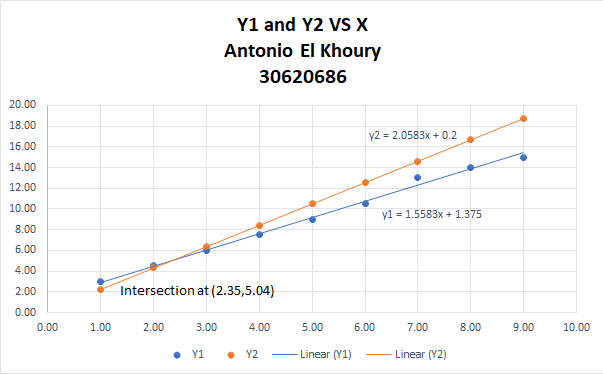
As indicated in the graph above, two materials are forming a linear graph. This happens because the materials are in their elastic region and their deformation is directly proportional to the force applied on the object.
Two lines can also be seen intersecting at point (2.35,5.04). This was calculated using simultaneous equations, indicating that the two objects have the same deformation of 5.04mm at a specific force x of 2.35N.
 Hooke's Law Experiment